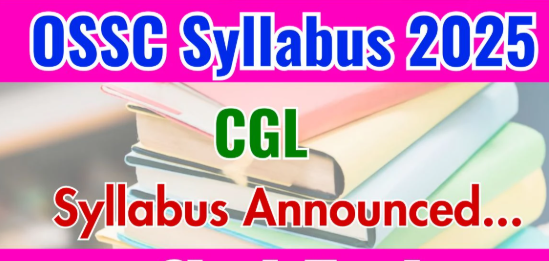
If you are preparing for the OSSC CGL exam, understanding the complete syllabus is the first and most important step. The good news is that the syllabus is very clear and mostly based on 10th and +2 level topics, so any serious student can cover it with the right plan.
OSSC CGL Exam Stages at a Glance
The OSSC CGL selection process mainly has four academic components:
- Preliminary Written Examination
- Main Written Examination – Paper I (Language)
- Main Written Examination – Paper II (General Studies)
- Computer Skill Test and Mathematics (where applicable)
Each stage checks a different skill set – basic maths and reasoning, language ability, general knowledge, computer skills and school‑level mathematics.
Preliminary Exam Syllabus
The Prelims is screening in nature and tests your basic aptitude and awareness.
- Arithmetic (10th Standard)
- Simple & compound interest, percentage, ratio, profit–loss, average, time & work, time–speed–distance, number system etc.
- Data Interpretation (10th Standard)
- Questions from charts, graphs, tables, pie‑charts and data sufficiency.
- Logical Reasoning & Analytical Ability
- Series, coding–decoding, analogies, puzzles, blood relations, direction sense, syllogism, basic mental ability.
- Current Events (National & International)
- Important news, government schemes, awards, sports, science & tech, major international events.
- Computer / Internet Awareness
- Basic computer terms, internet usage, common applications.
- Odisha‑Specific GK (10th Standard)
- Odisha Economy
- Odisha History
- Odisha Geography
- Odisha Heritage & Culture
If you are strong in Class 10 maths and read news daily, you already have a good base for Prelims.
Mains Paper I – Odia & English Language
This paper checks your reading and basic writing skills in both Odia and English.
- Odia Language Comprehension (10th Level)
- Reading passages in Odia and answering questions.
- English Language Comprehension (+2 Level)
- Unseen passages, understanding main idea, vocabulary from context.
- Grammar, Usage & Vocabulary (Odia + English, 10th Level)
- Parts of speech, tenses, prepositions, articles, active–passive, direct–indirect speech, spelling, synonyms, antonyms, idioms, one‑word substitutes, common errors.
Focus on school‑level grammar books and daily reading (newspapers, simple articles) in both languages.
Mains Paper II – General Studies (Plus Two Level)
This is the most scoring paper if you prepare smartly.
Covers:
- Indian Constitution – Preamble, Fundamental Rights & Duties, Directive Principles, Parliament, President, PM, Judiciary, constitutional bodies.
- Indian Economy & Odisha Economy & Budget – basics of growth, inflation, poverty, sectors of economy, Odisha’s budget highlights, key schemes.
- Indian & World Geography – physical geography, climate, resources, maps, important locations.
- History of India & Odisha – ancient, medieval, modern history; freedom struggle; important movements and personalities in Odisha.
- Arts & Culture (with special reference to Odisha) – temples, dance forms, music, festivals, literature and heritage of Odisha.
- Environment & Climate Change (Plus Two Level) – ecology basics, pollution, conservation, climate change, global initiatives.
NCERT books (Class 9–12) and an Odisha‑specific GK book are very useful here.
Computer Skill Test Syllabus
In many CGL posts, a Computer Skill Test is compulsory and qualifying. It is practical in nature.
You must know:
- Computer fundamentals & MS Windows
- Office software:
- MS Word – typing, formatting, tables, page setup
- MS Excel – basic formulas, sorting, filtering, charts
- MS PowerPoint – slides, animations, presentations
- MS Access – basic database concepts
- Internet usage – browsing, email, online forms
- Basic networking concepts and communication technology
Practice directly on a computer; theory alone is not enough.
Mathematics Paper (Secondary School Level)
For posts where maths is tested separately, the syllabus is school‑level:
- Arithmetic – same topics as Prelims but in more depth
- Algebra – equations, polynomials, simple identities, factorisation
- Statistics & Probability – mean, median, mode, simple probability, graphs
- Mensuration – area, perimeter, volume of 2D & 3D figures
Use your Class‑9/10 maths textbook and solve plenty of previous‑year questions.