Have you seen the news circulating on WhatsApp lately? If you live in Odisha, you definitely haven’t missed it.
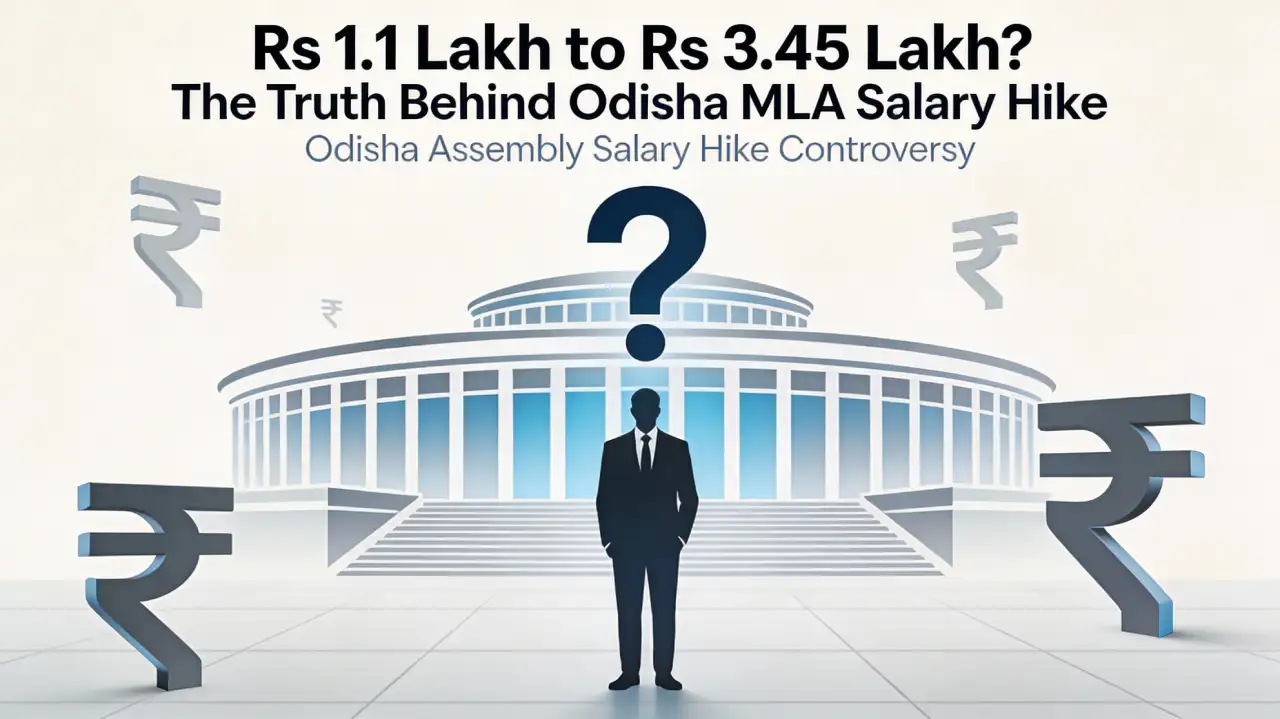
While most of us are calculating how to save a few hundred rupees on our monthly grocery bills, the Odisha Legislative Assembly just dropped a bombshell. Our MLAs have unanimously passed a bill to triple their monthly salary.
Yes, you read that right. Tripled.
From a monthly package of around ₹1.11 Lakh, an Odisha MLA will now take home approximately ₹3.45 Lakh every single month.
Many people are confused and angry, and social media is full of half-truths and forwarded messages. This blog will explain the issue in very simple language so that a normal reader can understand what is fact, what is confusion, and what still needs clarity.
Old vs. New Salary
Let’s look at the numbers because they are staggering. The hike isn’t just a small percentage increase to beat inflation; it’s a complete pay structure.
Here is what the new monthly slip for an MLA looks like:
- Basic Pay: Increased from ₹35,000 to ₹90,000.
- Constituency Allowance: Jumped from ₹20,000 to ₹75,000. (This is for them to tour their areas).
- Conveyance (Travel): Hiked from ₹15,000 to ₹50,000.
- Medical Allowance: Now ₹35,000 per month (Fixed, whether they fall sick or not).
- Electricity Allowance: Increased to ₹20,000 (That’s a lot of ACs running!).
When you add up all the other perks like telephone and stationary allowances, the total hits ₹3.45 Lakh per month.
Who Get How Much ?
Chief Minister: Will now draw approx ₹3.74 Lakh per month.
Speaker: Approx ₹3.68 Lakh per month.
Pension for Ex-MLAs: This is the part that surprised me the most. Even after they retire or lose an election, former MLAs will now get a pension of ₹80,000 plus allowances, totaling about ₹1.17 Lakh per month.
Why Are People Angry About This?
There are a few simple reasons why common people are upset:
- When government employees, teachers, or ASHA/Anganwadi workers struggle for small increments, a big hike for MLAs looks unfair.
- Odisha is still fighting issues like unemployment, low teacher-student ratio, poor health facilities in some areas – so a higher political salary sends a wrong message emotionally.
- The public feels that before raising MLAs’ salary, the government should show strong action on corruption, job creation, and public services.
If MLAs truly deliver good roads, schools, hospitals, and jobs, people may accept higher pay more easily. But if public services remain poor, any hike will look like an insult to voters.