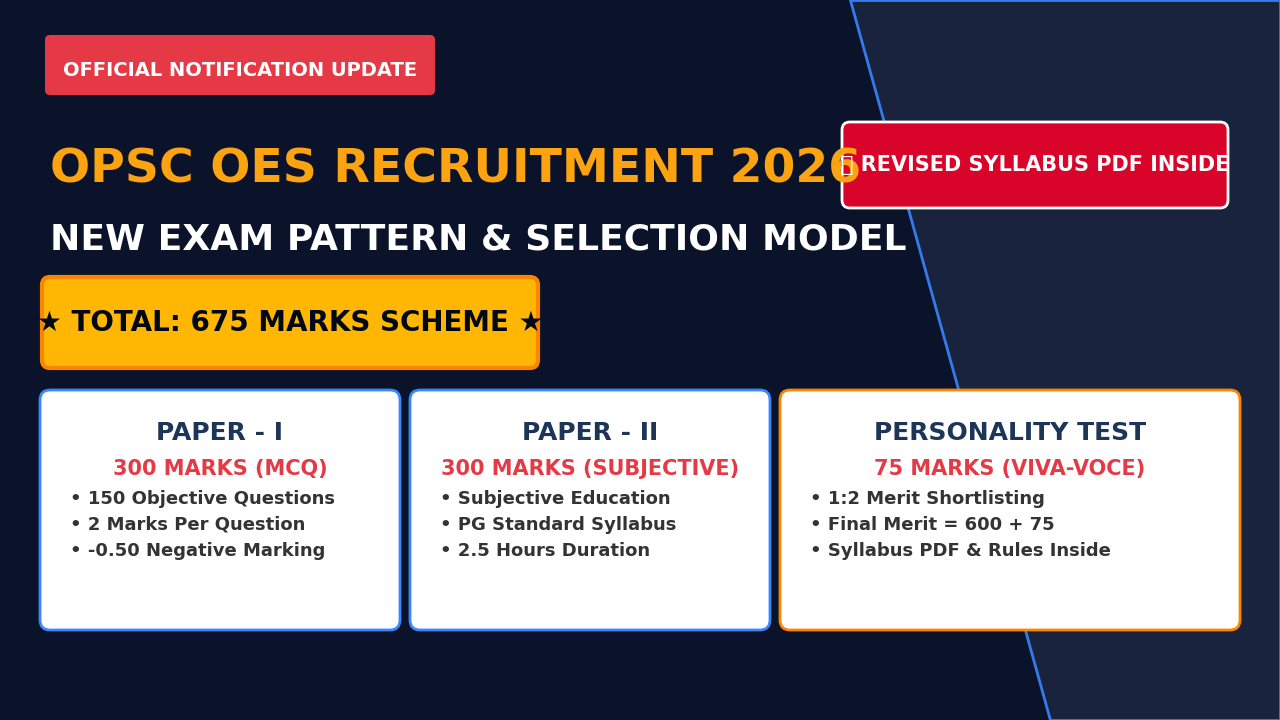
The Department of School & Mass Education, Government of Odisha has officially released Notification No. 21626/SME and Letter No. 21633/SME, prescribing a revised Scheme of Examination and Syllabus for direct recruitment to the Odisha Education Service (School Branch) Group-B cadre conducted by the Odisha Public Service Commission (OPSC).
This major update introduces a significant overhaul: the total selection evaluation has been restructured to 675 Marks (Written Examination: 600 Marks + Personality Test: 75 Marks). In addition, Paper-II (Education) will be conducted in a Subjective/Descriptive format at the Post-Graduate level, while Paper-I will be an Objective MCQ Test.
(Before diving into the detailed subject breakdown, download previous exam papers and question trends via our OES Previous Year Questions Download PDF & Topic-Wise Analysis and check the Recommended Book List for OES Exam Preparation).
Below is the complete analysis of the OPSC OES New Exam Pattern 2026, negative marking rules, subject-wise weightage, eligibility clarifications, and category-wise vacancy distribution for the 25 Group-B posts.
OPSC OES Exam Pattern 2026: High-Level Overview
The competitive examination will now be conducted in two stages: Written Examination and Personality Test/Interview.
| Exam Component | Pattern / Mode | Number of Questions | Duration | Maximum Marks |
| Paper-I (General Awareness, Odia, General English) | Objective (MCQ) (OMR / CBT) | 150 Questions | 2 Hours 30 Minutes | 300 Marks |
| Paper-II (Education) | Subjective (Descriptive) | Conventional / Descriptive | 2 Hours 30 Minutes | 300 Marks |
| Stage-I Written Total | 5 Hours | 600 Marks | ||
| Stage-II Personality Test / Interview | Oral Viva-Voce | — | — | 75 Marks |
| GRAND TOTAL | 675 Marks |
(Aiming for other administrative and leadership roles in Odisha? Explore our curated list of the Top 10 High-Paying Government Jobs in Odisha After Graduation).
Key Rules of the New Examination Scheme
OPSC OES 675 Marks Selection Model
- Objective MCQ (150 Questions)
- 2 Marks Per Correct Answer
- 25% Negative Marking (-0.50 Mark)
- Subjective / Descriptive
- Post-Graduate Degree Level
- Duration: 2.5 Hours
1. Marking Scheme for Paper-I (Objective)
- Total Questions: 150 MCQs carrying 2 marks each (Total: 300 Marks).
- Negative Marking: For each incorrect answer, 25% marks (0.50 marks) will be deducted from the candidate’s total score.
- Unattempted Questions: Zero marks awarded.
2. Nature of Paper-II (Subjective Education)
- Paper-II is entirely Subjective/Descriptive carrying 300 Marks with a duration of 2.5 hours.
- Questions will be framed strictly at the Post-Graduate (PG) standard covering Philosophy, Educational Psychology, and Educational Administration & Supervision.
3. Shortlisting Ratio for Interview
- Candidates securing minimum qualifying marks fixed by OPSC will be shortlisted for the Personality Test in the ratio of about 1:2 (subject to a minimum of 5 candidates per category quota).
4. Tie-Breaking Resolution
- If two or more candidates secure equal total marks (out of 675), merit will be decided based on higher aggregate marks secured in the Written Examination (600 Marks).
- If written marks are also tied, preference is given to the candidate with higher marks in their Master’s Degree Examination.
Detailed Syllabus Breakdown (Paper-I & Paper-II)
I. Paper-I: General Awareness, Odia & English (300 Marks – Objective)
Almost equal weightage is assigned across the three sections in Paper-I. General Awareness is set at the Graduate standard, while Odia and English are set at the +2 Higher Secondary standard.
A. General Awareness
- History of Modern India & Indian Culture: History of India since 1857, personalities of Freedom Movements in Odisha and India, social reform movements, temple architecture of Odisha, socio-cultural developments.
- Geography of India & Odisha: Physical, economic, and social geography; Odisha’s physiography, drainage system, natural resources (water, forest, minerals), climate, and disaster management (Floods, Cyclones, Tsunamis, Global Warming).
- Indian Polity & Odisha Governance: Constitution of India, political systems, government & politics in Odisha, Panchayati Raj Institutions (PRIs) in Odisha.
- India and the World: Foreign affairs, external security, international organizations (UN, IMF, World Bank, WTO).
- Indian & Odisha Economy: Planning, post-reform developments in India & Odisha corporate sector, trade issues, RBI functions.
- Science, Technology & AI: Inventions/discoveries, Information Technology, Artificial Intelligence (AI) and its evolving applications.
- Current Affairs: Events of State (Odisha), National, and International importance.
B. Odia Language (+2 Standard)
- Grammar (ବ୍ୟାକରଣ): କ୍ରିୟା, ଭ୍ରମ ସଂଶୋଧନ / ଚିହ୍ନଟ, କାଳ (ଅତୀତ, ବର୍ତ୍ତମାନ, ଭବିଷ୍ୟତ).
- Language Skills (ଭାଷାଜ୍ଞାନ): ପ୍ରତିଶବ୍ଦ, ବିପରୀତାର୍ଥବୋଧକ ଶବ୍ଦ, କ୍ରିୟା ବିଶେଷଣ, କର୍ତ୍ତା-କ୍ରିୟା ସମ୍ବନ୍ଧ.
- Comprehension & Rearrangement: ଅନୁଚ୍ଛେଦ ଏବଂ ବାକ୍ୟ ପୁନର୍ବିନ୍ୟାସ.
C. General English (+2 Standard)
- Grammar & Vocabulary: Verbs, Prepositions, Adverbs, Subject-Verb Agreement, Tenses, Error Recognition, Articles, Synonyms, Antonyms.
- Comprehension & Syntax: Reading Comprehension and Sentence Rearrangement.
II. Paper-II: Education (300 Marks – Subjective / PG Standard)
Paper-II evaluates deep theoretical and administrative knowledge in the field of Education:
PAPER-II SUBJECTIVE EDUCATION TOPICS
- Western Educational Thought
- Indian Educational Thought
- Education and Society
- Socialization & Modernization
- Culture and Education
- Learning Theories & Laws
- Motivation & Transfer
- Individual Differences
- Intelligence & Personality
- Mental Health & Adjustment
- Democratic Administrative Principles
- Regulatory Bodies: UGC, NCERT, AICTE
- Supervision Concepts & Educational Finance
- Five-Year Plans & Research in Administration
- Philosophy of Education: Contemporary Western and Indian educational thinkers; sociology of education, social control, social change, modernization, and cultural determinants.
- Educational Psychology:
- Learning: Nature, laws, transfer of training, motivation, and functional autonomy of motives.
- Individual Differences & Intelligence: Heredity vs environment, measuring special abilities, personality traits, and testing.
- Adjustment: Mental health, conflict resolution, defense mechanisms, and teacher mental wellness.
- Educational Administration & Supervision:
- Principles of administration in a democratic setup.
- Management structures: Central, State, and Local authorities; roles of UGC, NCERT, and AICTE.
- Supervision techniques, Grant-in-aid system, educational finance/expenditure, and educational research.
(Looking for a structured roadmap? Read our in-depth strategy guide on OES Exam Complete Guide to Syllabus, Pattern & Preparation).
OES SYLLABUS 2026 PDF – DOWNLOAD
Critical Eligibility Clarifications Issued by Government
The School and Mass Education Department has issued specific clarifications resolving common applicant doubts:
- M.A. (Education) vs M.Ed: Candidates holding M.A. in Education or M.Ed are equally eligible under the prescribed rules.
- B.Tech Degrees Not Eligible: B.Tech degrees are strictly NOT recognized as Bachelor’s Degrees in Science for OES recruitment.
- OS-CIT Computer Validity: The Odisha State Certificate in Information & Technology (OS-CIT) conducted by OKCL is officially approved as valid proof of basic computer knowledge alongside DCA/PGDCA/NIELIT ‘O’ Level.
- Reference Age Date: The reference date for age calculation (21 to 42 years) is fixed as 01.01.2026.
Approved Category-Wise Vacancy Breakdown (25 Posts)
Under the Post-Based Reservation Principle of the ORV Act and the 50% reservation limit concurred by the ST & SC Development Department, the 25 vacancies are allocated as follows:
| Category | Reservation Percentage | Sanctioned Cadre Strength | In Position | Vacancies to Fill |
| Scheduled Tribe (ST) | 22.50% | 38 | 28 | 10 Posts |
| Scheduled Caste (SC) | 16.25% | 27 | 23 | 04 Posts |
| SEBC | 11.25% | 19 | 15 | 04 Posts |
| Unreserved (UR) | 50.00% | 85 | 78 | 07 Posts |
| TOTAL | 100% | 169 Posts | 144 | 25 Posts |
(Need a focused environment to practice descriptive answer writing? Explore our guide to the Best Free Libraries and Reading Rooms in Bhubaneswar).
Related OES Resources on LearnOdisha
- OES Previous Year Questions Download PDF & Topic Analysis
- OES School Branch Official Syllabus Complete Details
- Best Recommended Books for OES Exam Preparation
- Odisha Shishu Vatika Teacher Recruitment Complete Guide
- SSB TGT Previous Year Question Papers & Answer Keys
Frequently Asked Questions (FAQs)
What is the total mark in the revised OPSC OES Exam Pattern 2026?
The total marks for selection is 675 Marks, comprising 600 marks in the Written Examination (Paper-I: 300 + Paper-II: 300) and 75 marks in the Personality Test/Interview.
Is Paper-II in the OES exam objective or subjective?
As per Notification No. 21626/SME, Paper-II (Education) is Subjective (Descriptive) at the Post-Graduate level. Paper-I is Objective (MCQ).
Is OS-CIT computer certificate accepted for OES recruitment?
Yes. The Government of Odisha has confirmed that the OS-CIT course of OKCL is valid proof of basic computer knowledge for OES recruitment.
Can B.Tech degree holders apply for the OES Group-B posts?
No. The School and Mass Education Department has explicitly clarified that a B.Tech degree will not be considered equivalent to a Bachelor’s Degree in Science for this recruitment.







Plz clear my confusion regarding my MA in education course
Please clear my confusion regarding MA in education.