The Odisha Public Service Commission (OPSC) and the School & Mass Education Department have introduced a major structural change in the Odisha Education Service examination: Paper-II (Education) is now completely subjective and descriptive.
Carrying a massive 300 Marks out of the 600-mark written total, Paper-II is set at the Post-Graduate (PG) standard and will serve as the decisive factor in qualifying candidates for the 75-mark Personality Test.
Success in this paper requires not just memorization, but the ability to structure analytical, coherent, and well-substantiated theoretical answers under strict time constraints.
(Before starting your preparation, ensure you review the complete master scheme in our OPSC OES New Exam Pattern 2026 Master Pillar Guide, confirm your degree eligibility in our OPSC OES Eligibility & OS-CIT Rules Guide, and master the objective section with our OPSC OES Paper-I Syllabus & Study Guide).
Here is the complete topic-wise breakdown of the OPSC OES Paper-II Education Syllabus 2026, along with unit structures and proven descriptive answer-writing strategies.
OPSC OES Paper-II (Education): Key Overview
| Feature Parameter | Official Details |
| Paper Title | Paper-II: Education |
| Question Format | Subjective / Descriptive (Conventional Written Pattern) |
| Standard / Academic Level | Post-Graduate (PG) Degree Standard (M.A. Education / M.Ed) |
| Total Marks | 300 Marks |
| Duration of Test | 2 Hours 30 Minutes (150 Minutes) |
| Role in Final Selection | Marks count directly towards written total (600) and final merit (675) |
Complete Unit-Wise Syllabus Breakdown (PG Standard)
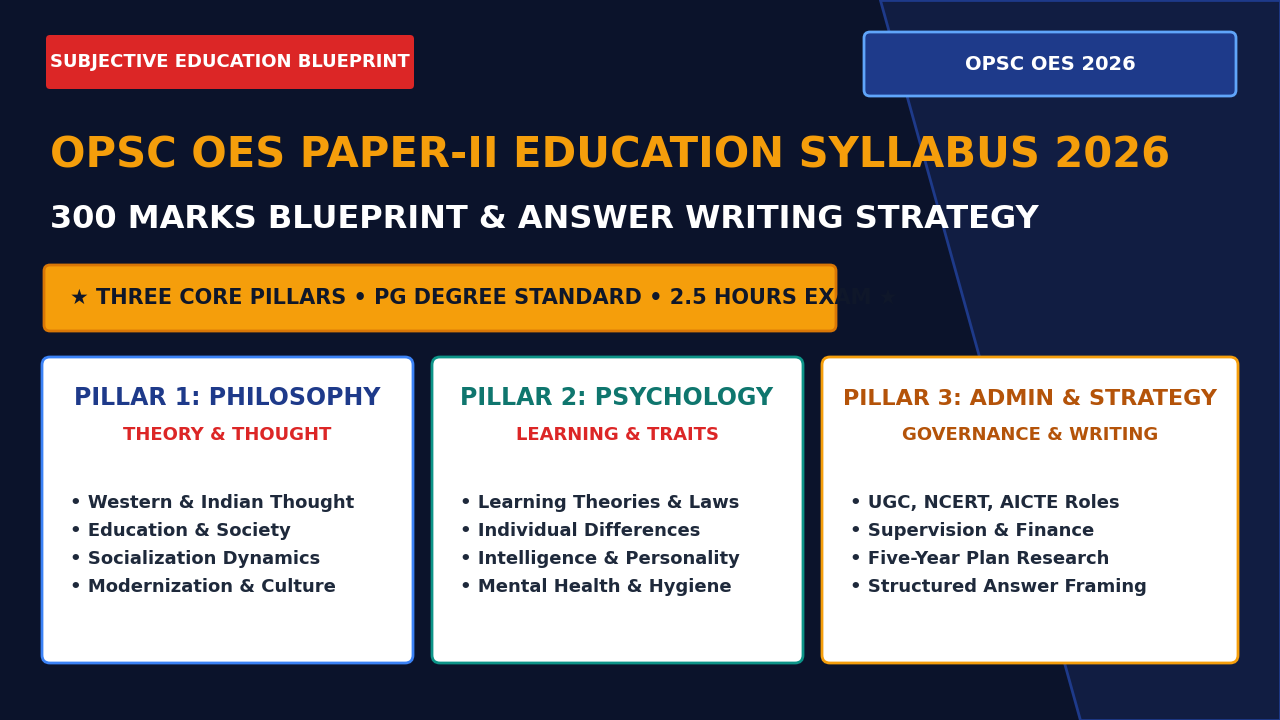
The syllabus for Paper-II is divided into three core pillars: Philosophy of Education, Educational Psychology, and Educational Administration & Supervision.
Paper-II Education: Three Core Pillars
PHILOSOPHY OF EDUCATION
- Western Thought
- Indian Thought
- Society & Culture
- Socialization & Modernization
EDUCATIONAL PSYCHOLOGY
- Learning Theories
- Individual Differences
- Intelligence Testing
- Personality Traits
- Mental Health
EDUCATIONAL ADMINISTRATION & SUPERVISION
- Democratic Admin
- UGC, NCERT, AICTE
- Supervision Models
- Educational Finance
- Five-Year Plans
Section A: Philosophy of Education
This section focuses on foundational educational philosophies, sociological dimensions, and the interplay between culture and schooling:
- Educational Thought: Contemporary Western educational thought and contemporary Indian educational thought (e.g., Rousseau, Dewey, Gandhi, Tagore, Sri Aurobindo).
- Sociology of Education: Education and society, education as an instrument of social control and social change.
- Socialization & Modernization: The process of socialization, modernization, and the role of schools in democratic social transition.
- Culture & Education: Determinants of culture, cultural transmission, cultural lag, and the dynamic relationship between culture and education.
Section B: Educational Psychology
This domain evaluates psychological foundations, developmental needs, behavioral challenges, and assessment of human traits:
- Learning: Nature and scope of learning; theories of learning (Behaviorism, Cognitivism, Constructivism) and primary laws of learning; transfer of learning and training; motivation and the concept of functional autonomy of motives.
- Individual Differences: Differences attributable to heredity versus environment; types and extent of individual differences; educational provisions and adaptations for learner diversity.
- Intelligence: Nature and theories of intelligence; measurement of general intelligence and special abilities; standardized psychological tests and test administration principles.
- Personality and Its Measurement: Conceptual definitions of personality; trait theories and type approaches; objective and projective techniques for measuring personality.
- Adjustment & Mental Hygiene: Mental health and adjustment mechanisms; conflicts, frustrations, and psychological complexes; defense mechanisms (rationalization, sublimation, projection, etc.); managing classroom behavior problems; and preserving teacher mental health.
Section C: Educational Administration and Supervision
This section covers educational governance, structural control, institutional financing, and planning:
- Administrative Principles: Scope of educational administration and its determining factors; fundamental principles of educational administration in a democracy.
- Educational Control and Management: Powers, functions, and organizational hierarchy of Central, State, and Local educational authorities; roles and mandates of key central agencies including UGC, NCERT, and AICTE.
- Educational Supervision: Concept, scope, and modern principles of supervision; supervisory objectives; planning, organization, and supervisory techniques (clinical supervision, democratic inspection).
- Educational Finance: Scope and principles of educational finance; sources of income (Central, State, Local, and Private funding); Grant-in-aid systems; patterns of educational expenditure.
- Planning, Organization and Research: Educational provisions in Five-Year Plans; constitutional mandates for equality of educational opportunity; education of children with disabilities (inclusive education); research methodologies in educational administration.
(To benchmark your conceptual preparation against previous exam questions, download our OES Previous Year Questions PDF & Detailed Topic-Wise Analysis and reference the Best Recommended Books for OES Preparation).
5-Step Descriptive Answer Writing Strategy for OES Paper-II
Because Paper-II is descriptive and evaluated at the PG standard, quality of articulation and structural clarity are critical:
- Structure with Clear Sub-Headings: Begin every answer with a crisp introduction defining core terms, followed by labeled thematic sections, bulleted analytical points, and a forward-looking conclusion.
- Incorporate Theoretical Frameworks: When discussing pedagogical or administrative issues, cite relevant thinkers (e.g., John Dewey, Rabindranath Tagore) and official policy documents (e.g., NEP 2020, NCF) to substantiate your arguments.
- Use Conceptual Diagrams & Flowcharts: Where appropriate, draw neat conceptual diagrams illustrating organizational hierarchies, learning cycles, or administrative workflows to make your answers stand out.
- Balance Theory with Administrative Application: As an aspiring Education Service Officer, ground theoretical concepts in practical classroom realities, institutional supervision challenges, and policy implementation in Odisha.
- Manage Your Time Strictly: With 300 marks to cover in 150 minutes, allocate your writing time proportionately according to the mark weightage of each question.
(Looking for quiet, dedicated study environments to practice daily long-form answer writing? Explore our guide to the Best Free Libraries and Reading Rooms in Bhubaneswar).
Related OES & Education Recruitment Articles on LearnOdisha
- OPSC OES New Exam Pattern 2026: 675 Marks Scheme & Rules
- OPSC OES Eligibility Criteria 2026: MA Education vs MEd & OS-CIT Rules
- OPSC OES Paper-I Syllabus 2026: General Awareness, Odia & English
- OES Previous Year Questions Download PDF & Topic-Wise Analysis
- Top 10 High-Paying Government Jobs in Odisha After Graduation
Frequently Asked Questions (FAQs)
What is the total mark for OPSC OES Paper-II (Education)?
Paper-II carries a maximum of 300 Marks and has a test duration of 2 hours and 30 minutes.
Is Paper-II in the OES exam objective or subjective?
Under Notification No. 21626/SME, Paper-II is strictly Subjective/Descriptive in nature at the Post-Graduate standard.
Which major areas are covered in the OES Education syllabus?
The syllabus covers three broad domains: Philosophy of Education, Educational Psychology, and Educational Administration & Supervision.
Will there be negative marking in Paper-II?
No. Negative marking applies only to the objective MCQ format of Paper-I (25% deduction). Paper-II is evaluated as a conventional descriptive paper.