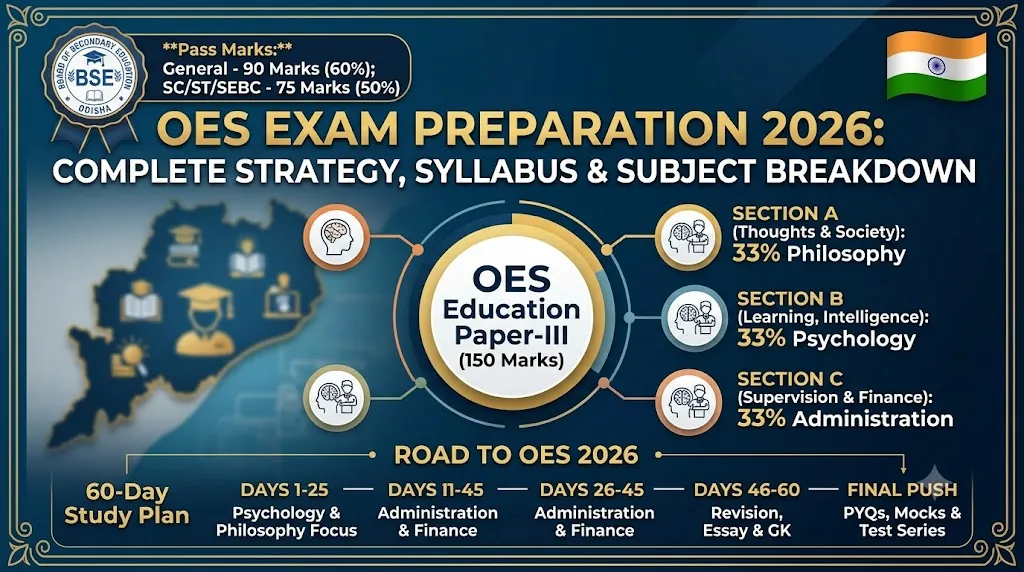
The Odisha Education Service (OES) School Branch (Group-B) recruitment is one of the most prestigious administrative examinations conducted for education professionals and postgraduates in Odisha. Serving as an OES officer gives you the administrative authority to supervise schools, manage educational policies, and drive educational reforms across various districts of Odisha.
Because the OES exam tests both general administrative skills and deep domain knowledge in Education, having a clear understanding of the 3-paper examination scheme and official syllabus is critical to scoring high.
(Before diving into the detailed preparation plan, explore our core resources on OES Previous Year Question Papers & Topic-Wise Analysis and the Recommended Book List for OES Exam Preparation).
In this ultimate guide, we break down the official OES syllabus, paper-wise marks distribution, topic weightage, and a proven preparation strategy to help you clear the OES exam on your first attempt.
OES Exam Pattern & Scheme of Examination
The OES (School Branch) competitive examination consists of 3 written papers. Each paper has an official duration of 2 hours.
| Paper | Subject Name | Academic Standard | Total Duration | Maximum Marks |
| Paper-I | General English | Graduate Degree Standard | 2 Hours | 100 Marks |
| Paper-II | General Knowledge | General Educated Standard | 2 Hours | 100 Marks |
| Paper-III | Education | Post-Graduate (PG) Standard | 2 Hours | 150 Marks |
| TOTAL | 6 Hours | 350 Marks |
(Aiming for top administrative or managerial positions in the state? Check out our list of the Top 10 High-Paying Government Jobs in Odisha After Graduation).
Official OES Syllabus: Detailed Subject Breakdown
Paper-I: General English (100 Marks)
Paper-I is designed to evaluate a candidate’s understanding, expression, and command of descriptive English at the Graduate degree level:
- Essay Writing (50 Marks): Candidates are required to write a detailed, well-structured essay on a given topic (social issues, educational trends, contemporary administrative challenges, or general topics).
- Precis & Letter Writing (50 Marks): Tests candidates’ power of concise summarizing (Précis) and official/formal correspondence (Letter writing).
Paper-II: General Knowledge (100 Marks)
Paper-II evaluates everyday observation, scientific awareness, and general awareness expected of an educated graduate without specialized scientific study:
- Current Events: National and international news, state initiatives, awards, and sports.
- Everyday Science: Scientific aspects of daily observation and experience.
- Indian History: Major historical eras, freedom movement, and cultural heritage.
- Indian Geography: Physical, economic, and social geography of India and Odisha.
Paper-III: Education (150 Marks – PG Standard)
The Education paper is the decisive game-changer in the OES examination. Set at the Post-Graduate (M.A. Education / M.Ed) level, it carries 150 marks and is divided into three major domains:
A. Philosophy of Education
- Educational Thoughts: Contemporary Western educational thought and contemporary Indian educational thought.
- Education & Society: Relationship between education and society, social control, social change, processes of socialization and modernization, determinants of culture, and culture-education interaction.
B. Educational Psychology
- Learning: Nature and scope of learning, theories and laws of learning, transfer of training, motivation, and functional autonomy of motives.
- Individual Differences: Heredity vs. environment influences, types and extent of individual differences, and educational provisions for individual differences.
- Intelligence & Personality: Nature and measurement of intelligence, special abilities and test administration, traits and measurement of personality.
- Adjustment & Mental Health: Mental health concepts, conflict, frustrations, complexes, defense mechanisms, behavior problems in schools, and teacher’s mental health.
C. Educational Administration, Supervision & Finance
- Principles & Control: Scope and determining factors of educational administration in a democracy; Central, State, and Local educational authorities (organization, powers, and functions).
- Central Agencies: Structure and role of UGC, NCERT, and AICTE.
- Supervision: Concept, scope, principles, objectives, planning, organization, and techniques of educational supervision.
- Educational Finance: Sources of income (Central, State, Local, Private), Grant-in-aid principles, and educational expenditure patterns.
- Planning, Organization & Research: Five-Year Plans, equality of educational opportunity, education for handicapped children, and research in educational administration.
DOWNLOAD OES SYLLABUS PDF- DOWNLOAD
Paper-Wise OES Preparation Strategy
1. Mastering Descriptive English (Paper-I)
- Practice Précis & Summary: Practice reducing passages to one-third of their original length while retaining core ideas.
- Essay Preparation: Prepare strong introduction and conclusion templates for education-centric essays (e.g., National Education Policy, Digital Education in Rural Odisha, Women Empowerment through Literacy).
- Letter Writing: Learn formal letter formats (letters to editors, departmental memos, official representations).
2. Tackling General Knowledge (Paper-II)
- Focus on Odisha History & Geography: Questions on Odisha’s geography, major rivers, mineral resources, and freedom movements are frequently asked.
- Current Affairs: Read daily national news summaries focusing on government schemes, education policies, and state welfare initiatives.
- Everyday Science: Revise basic 9th and 10th standard science concepts (Physics, Chemistry, Life Sciences).
3. Cracking the 150-Mark Education Paper (Paper-III)
- Philosophy: Focus on Indian thinkers (Swami Vivekananda, Sri Aurobindo, Rabindranath Tagore, Mahatma Gandhi) and Western philosophies (Idealism, Realism, Naturalism, Pragmatism).
- Psychology: Thoroughly study theories of learning (Pavlov, Skinner, Thorndike, Piaget, Vygotsky) and intelligence testing (Binet, Spearman, Gardner).
- Administration & Supervision: Make clear notes on central bodies (NCERT, UGC, AICTE) and grant-in-aid mechanisms in Odisha education.
(Preparing for other major teaching eligibility exams alongside OES? Read our OSSTET 2026 Master Notification & Preparation Guide).
Recommended Study Routine (60-Day Master Plan)
- Dedicated Study Space: Preparing for long descriptive papers requires sustained focus. Find quiet reading spaces using our guide to the Best Free Libraries and Reading Rooms in Bhubaneswar.
Helpful OES & Education Resources on LearnOdisha
- OES Previous Year Questions Download (PDF & Topic-Wise Analysis)
- Book List for OES Exam Preparation: Best Recommended Books
- OES Official Syllabus Complete Details & Guidelines
- SSB TGT Previous Year Question Papers & Answer Keys Download
Frequently Asked Questions (FAQs)
What is the full form of OES?
OES stands for Odisha Education Service. The Group-B School Branch recruitment is conducted to fill administrative posts within the Department of School & Mass Education, Govt. of Odisha.
What is the academic standard of the OES Education paper?
The Education paper (Paper-III) is set at the Post-Graduate (PG) Degree standard and carries 150 marks.
How many papers are there in the OES School Branch examination?
There are 3 written papers: General English (100 Marks), General Knowledge (100 Marks), and Education (150 Marks), making a total of 350 marks. Each paper lasts 2 hours.
Can candidates without an M.A. in Education or M.Ed prepare for OES?
Yes, provided they satisfy the official educational eligibility criteria set in the recruitment advertisement. A disciplined study plan covering PG-level educational psychology, philosophy, and administration is key to clearing the exam.