Securing a high score in the Odisha Education Service (School Branch) Group-B examination requires a deep understanding of the newly revised examination structure. The Odisha Public Service Commission (OPSC) has introduced a comprehensive two-stage evaluation process, where Paper-I acts as the core objective scoring test.
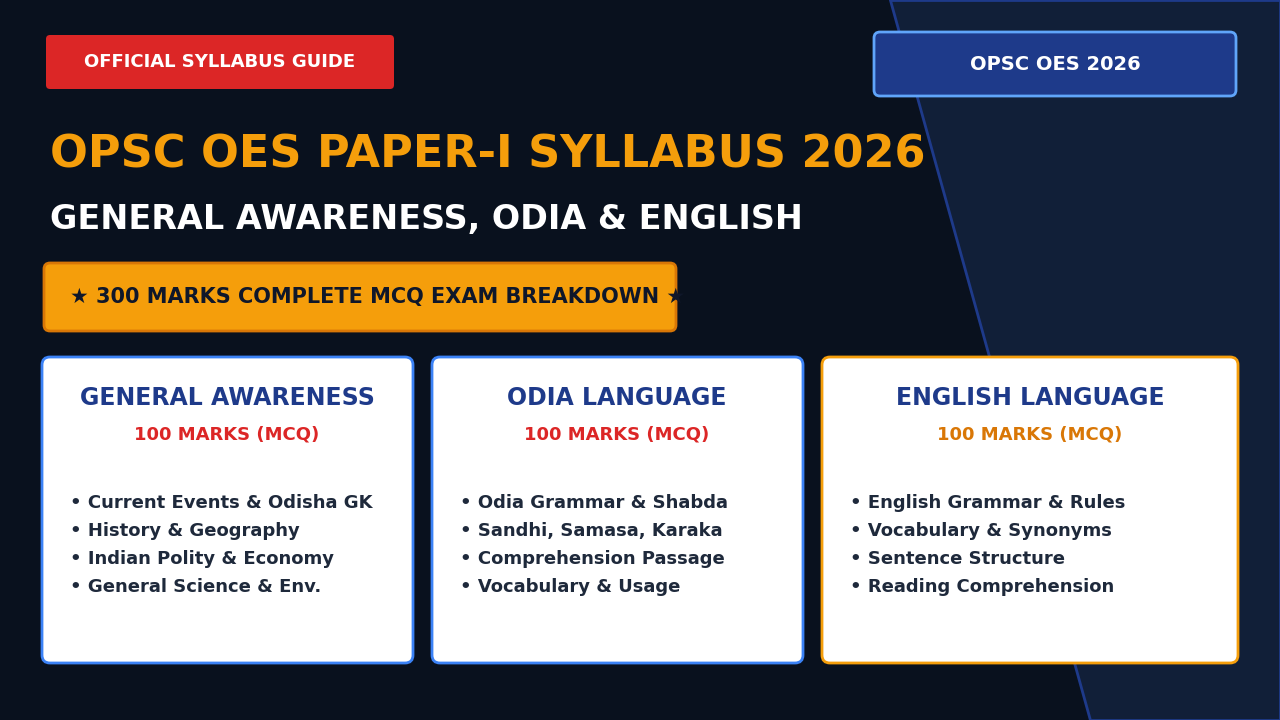
Paper-I evaluates candidates across three diverse subjects: General Awareness, Odia language, and General English. Mastering this 300-mark paper is absolutely crucial, as it sets the foundation for your final merit ranking alongside the subjective Paper-II.
(Ensure you are fully caught up with the recent structural changes by reading our complete master guide on the OPSC OES New Exam Pattern 2026 & Revised Syllabus Scheme and verify your degree status in our OPSC OES Eligibility Criteria & OS-CIT Rules Guide).
Here is the exhaustive, topic-wise breakdown of the OPSC OES Paper-I Syllabus 2026, including marking schemes, subject weightage, and the prescribed difficulty standards.
OPSC OES Paper-I: Examination Pattern & Marking Scheme
The Paper-I examination is designed to test objective knowledge, accuracy, and time management through a Multiple Choice Question (MCQ) format. The examination will be conducted either via Optical Mark Recognition (OMR) or as a Computer-based Test (CBT).
| Exam Parameter | Official Details |
| Paper Type | Objective Type Multiple Choice Questions (MCQ) |
| Total Questions | 150 Questions |
| Marks Per Question | 2 Marks |
| Total Marks | 300 Marks |
| Exam Duration | 2 Hours 30 Minutes (2.5 Hours) |
| Negative Marking | 25% Deduction (0.50 marks deducted for every wrong response) |
| Un-attempted Questions | Zero marks awarded |
📌 Weightage Rule: OPSC will give almost equal weightage to all three components (General Awareness, Odia, and General English) when setting the question paper.
Part I: General Awareness Syllabus (Graduate Standard)
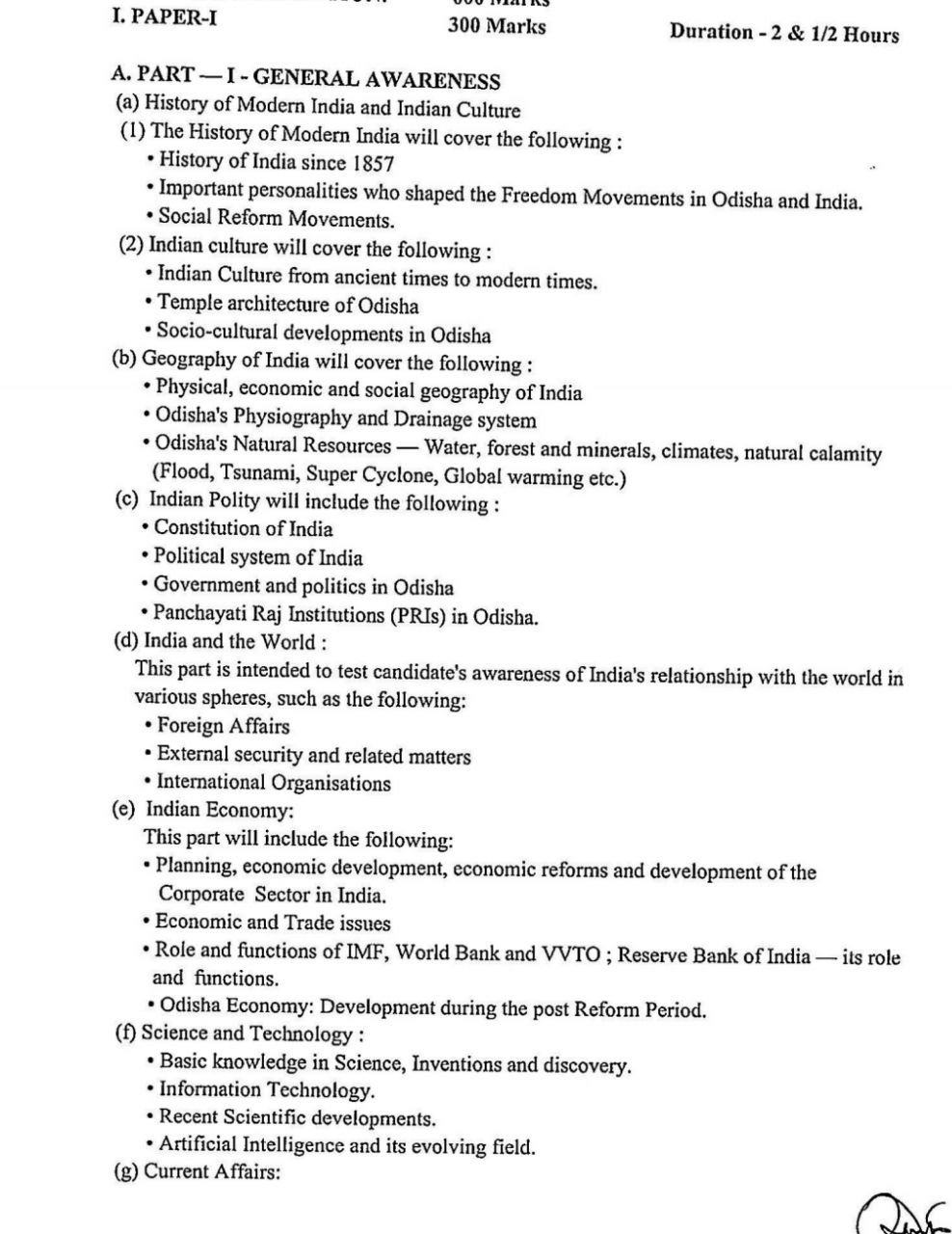
The General Awareness section is set at the standard expected from a candidate possessing a graduate qualification. It spans seven broad categories, testing knowledge of historical, geographical, political, and technological landscapes.
1. History of Modern India and Indian Culture
- History of India since 1857.
- Important personalities who shaped the Freedom Movements in Odisha and India.
- Social Reform Movements.
- Indian Culture from ancient times to modern times.
- Temple architecture of Odisha.
- Socio-cultural developments in Odisha.
2. Geography of India & Odisha
- Physical, economic, and social geography of India.
- Odisha’s Physiography and Drainage system.
- Odisha’s Natural Resources: Water, forest, and minerals.
- Climates and natural calamities (Flood, Tsunami, Super Cyclone, Global warming, etc.).
3. Indian Polity & Governance
- Constitution of India and the political system of India.
- Government and politics in Odisha.
- Panchayati Raj Institutions (PRIs) in Odisha.
4. India and the World
- Foreign Affairs and external security matters.
- International Organisations.
5. Indian Economy
- Planning, economic development, economic reforms, and development of the Corporate Sector in India.
- Economic and Trade issues.
- Role and functions of IMF, World Bank, WTO, and the Reserve Bank of India (RBI).
- Odisha Economy: Development during the post-Reform Period.
6. Science and Technology
- Basic knowledge in Science, inventions, and discovery.
- Information Technology and recent scientific developments.
- Artificial Intelligence and its evolving field.
7. Current Affairs
- Important current affairs and events of national and international importance.
Part II: Odia Language Syllabus (+2 Standard)
The Odia language section will be evaluated at the Higher Secondary (+2) standard. It focuses on core grammatical concepts, vocabulary, and sentence structuring.
- ବ୍ୟାକରଣ (Grammar): କ୍ରିୟା (Verbs), ଭ୍ରମ ସଂଶୋଧନ / ଚିହ୍ନଟ (Error Correction/Identification), କାଳ – ଅତୀତ / ବର୍ତମାନ / ଭବିଷ୍ୟତ (Tense – Past/Present/Future).
- ଭାଷାଜ୍ଞାନ ପରୀକ୍ଷା (Language Skills): ପ୍ରତିଶବ୍ଦ (Synonyms), ବିପରୀତ ଅର୍ଥବୋଧକ ଶବ୍ଦ (Antonyms), କ୍ରିୟା ବିଶେଷଣ (Adverbs), କର୍ଷା-କ୍ରିୟା ସମ୍ୱନ୍ଧ (Subject-Verb Agreement).
- Reading & Structure: ଅନୁଚ୍ଛେଦ (Comprehension Passage) and ବାକ୍ୟ ପୁନର୍ବିନ୍ୟାସ (Sentence Rearrangement).
Part III: General English Syllabus (+2 Standard)
Similar to Odia, the General English section is maintained at the Higher Secondary (+2) standard, designed to assess foundational English language proficiency.
- Grammar & Vocabulary: Verbs, Prepositions, Adverbs, Subject-Verb Agreement, Error Correction / Recognition, Tenses, Fill in the Blanks with Articles, Vocabulary, Synonyms, and Antonyms.
- Comprehension: Reading and analyzing unseen passages.
- Sentence Rearrangement: Logically ordering jumbled sentences.
(To maximize your score in this section, practice extensively using our OES Previous Year Questions Download PDF & Topic-Wise Analysis).
Winning Strategy for Paper-I
- Balance Your Prep: Because OPSC assigns almost equal weightage across General Awareness, Odia, and English, you cannot afford to neglect the language sections. Consistent grammar practice is an easy way to secure high marks.
- Beware of the 25% Penalty: With a negative marking of 0.50 marks per incorrect answer, wild guessing will severely damage your total score. Only attempt questions where you can eliminate at least two options.
- Focus on Tech & Odisha Economy: The inclusion of Artificial Intelligence, post-reform Odisha economy, and disaster management highlights OPSC’s shift toward modern administrative challenges. Prepare specific notes for these sub-topics.
(Need a focused environment to take mock tests? Explore our guide to the Best Free Libraries and Reading Rooms in Bhubaneswar).
Frequently Asked Questions (FAQs)
How many questions are there in OPSC OES Paper-I?
Paper-I consists of 150 objective-type Multiple Choice Questions (MCQs).
What is the total duration and marks for Paper-I?
The total duration of the examination is 2 hours and 30 minutes (2.5 hours), and it carries a maximum of 300 marks.
Is there any negative marking in the OES Paper-I exam?
Yes. There is a negative marking of 25%, meaning 0.50 marks will be deducted for every incorrect response.
What is the difficulty level of the General English and Odia sections?
The standard of questions for both General English and Odia language sections will be of the +2 (Higher Secondary) level.