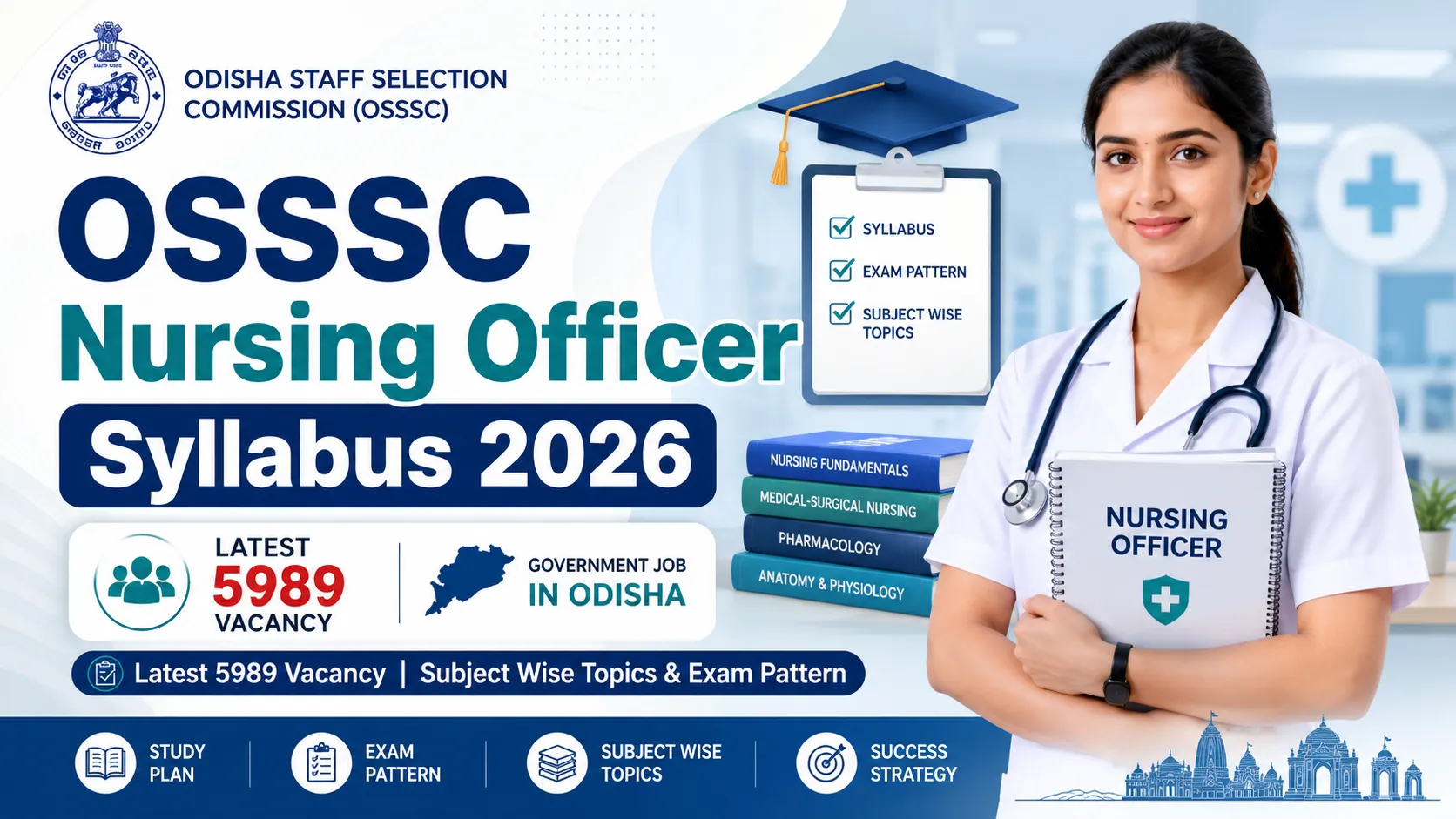
The OSSSC Nursing Officer syllabus has become one of the most searched topics after the release of the latest 5,989 vacancy notification. If you are planning to apply for this post, then understanding the syllabus properly is the first step toward smart preparation.
In this post, you will get the full OSSSC Nursing Officer syllabus in simple words, subject-wise breakdown, exam pattern, and preparation tips so that you can start preparing without confusion.
OSSSC Nursing Officer Exam Pattern
Before reading the syllabus in detail, it is important to understand the exam pattern. As per the latest available exam information, the written exam is expected to be objective type with 100 multiple-choice questions for 100 marks, and the duration is 2 hours. Negative marking of 0.25 marks for each wrong answer is also mentioned in the current exam details.
The syllabus is mainly based on nursing subjects, practical nursing skills, arithmetic, and English. The nursing portion carries the biggest weightage, so candidates should focus more on core nursing topics.
Exam Structure at a Glance
| Section | Topics Covered | Marks |
|---|---|---|
| Nursing Subjects | GNM/B.Sc Nursing theory areas | 60 |
| Practical Nursing Skills | Clinical and practical nursing tasks | 25 |
| Arithmetic | HSC standard maths | 10 |
| English | HSC standard English | 5 |
The above structure is supported by the latest exam pattern details shared in public sources.
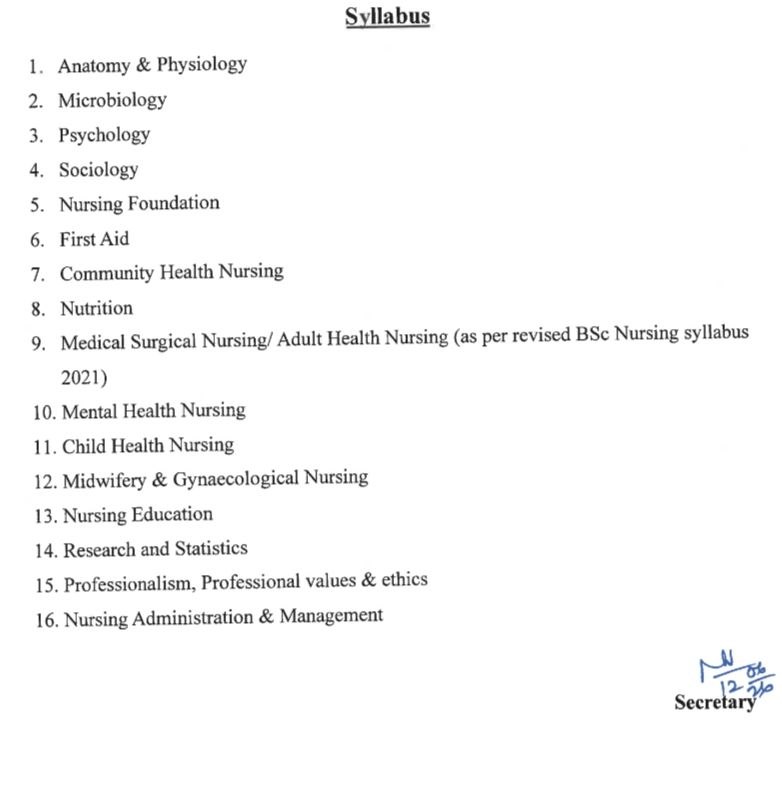
OSSSC Nursing Officer Syllabus Topic Wise
The latest syllabus image you shared shows the following major nursing areas: Anatomy & Physiology, Microbiology, Psychology, Sociology, Nursing Foundation, First Aid, Community Health Nursing, Nutrition, Medical Surgical Nursing, Mental Health Nursing, Child Health Nursing, Midwifery & Gynaecological Nursing, Nursing Education, Research and Statistics, Professionalism and ethics, and Nursing Administration & Management. These are the core topics you should cover one by one.
Below is the syllabus broken into easy sub-topics so readers can understand what to study under each heading.
1. Anatomy & Physiology
This is one of the most important base subjects in nursing. It helps you understand how the human body works, which is necessary for almost every other nursing topic.
Study the following sub-topics:
- Structure and functions of the human body.
- Cells, tissues, organs, and body systems.
- Digestive, respiratory, circulatory, nervous, muscular, and endocrine systems.
- Basic human anatomy terms.
- Common diseases related to body systems.
2. Microbiology
This subject deals with micro-organisms and infection control. It is a practical and scoring subject if studied properly.
Important sub-topics:
- Bacteria, viruses, fungi, and parasites.
- Infection and immunity.
- Sterilization and disinfection.
- Hospital-acquired infection.
- Basic laboratory concepts.
- Principles of infection prevention.
3. Psychology
Psychology helps nurses understand patient behaviour, stress, emotions, and mental reactions. It is useful in both theory and patient care.
Study these points:
- Human behaviour and development.
- Learning, memory, and motivation.
- Stress and coping.
- Personality basics.
- Emotional health.
- Psychology in nursing care.
4. Sociology
Sociology helps nurses understand society, family, culture, and community life. This is useful for community and hospital-based nursing.
Important topics:
- Society and social structure.
- Family, marriage, and culture.
- Social problems and health.
- Community health concepts.
- Socialization and social change.
- Role of nurses in society.
5. Nursing Foundation
This is the heart of nursing preparation. Many practical and theory questions come from this area.
Focus on:
- Principles of nursing.
- Patient admission and discharge.
- Vital signs.
- Bed making.
- Personal hygiene.
- Positioning and movement of patients.
- Infection control.
- Documentation and reporting.
6. First Aid
First aid is a practical topic and can help you score easy marks. It also builds confidence for real-life emergencies.
Study:
- Basic first aid meaning and goals.
- First aid in burns, cuts, fractures, and bleeding.
- CPR and emergency response.
- Shock management.
- Snake bite and poisoning.
- Transporting injured patients.
7. Community Health Nursing
This topic is very important for public health and field nursing. Questions may come from health programs and basic community care.
Sub-topics:
- Principles of community health nursing.
- Primary health care.
- Immunization.
- Maternal and child health services.
- Health education.
- National health programs.
- Home visits and rural health services.
8. Nutrition
Nutrition is a useful subject for both nursing theory and patient care. It helps in understanding diet planning and disease prevention.
Study these areas:
- Balanced diet.
- Nutrients and their functions.
- Nutrition during pregnancy, lactation, childhood, and old age.
- Malnutrition.
- Therapeutic diets.
- Diet in common diseases.
9. Medical Surgical Nursing / Adult Health Nursing
This is one of the biggest and most important sections of the syllabus. It covers adult patient care and common medical and surgical conditions.
Important sub-topics:
- Pre-operative and post-operative care.
- Signs and symptoms of common diseases.
- Fluid and electrolyte balance.
- Oxygen therapy.
- Wound care.
- Shock, fever, and pain management.
- Nursing care in respiratory, cardiac, digestive, renal, and neurological disorders.
10. Mental Health Nursing
This subject focuses on mental illness, behaviour, and psychiatric nursing care. It is an important area for both theory and practice.
Study:
- Mental health and mental illness.
- Common psychiatric disorders.
- Therapeutic communication.
- Counseling basics.
- Stress management.
- Nurse’s role in mental health care.
11. Child Health Nursing
This topic deals with newborns, infants, and children. It is important for growth, development, and pediatric care.
Key areas:
- Growth and development.
- Child health assessment.
- Neonatal care.
- Common childhood diseases.
- Immunization schedule.
- Nutrition for children.
- Nursing care in pediatric wards.
12. Midwifery & Gynaecological Nursing
This subject is very important in nursing officer exams because it covers women’s health, pregnancy, labor, and postnatal care.
Study:
- Anatomy and physiology of the female reproductive system.
- Antenatal, intranatal, and postnatal care.
- Normal delivery and complications.
- Family planning.
- High-risk pregnancy.
- Common gynecological problems.
- Newborn care.
13. Nursing Education
This topic helps in understanding teaching methods used in nursing. It is useful for patient education and staff training.
Important sub-topics:
- Principles of teaching and learning.
- Methods of health education.
- Lesson planning.
- Teaching aids.
- Evaluation methods.
- Role of the nurse as an educator.
14. Research and Statistics
This area may look difficult at first, but basic concepts are easy to understand if you study them step by step.
Study:
- Meaning of research.
- Types of research.
- Steps in research process.
- Data collection.
- Basic statistics.
- Tables, graphs, averages, and interpretation.
15. Professionalism, Values and Ethics
This subject is about nursing behaviour, responsibility, and professional conduct. It is important for both exam and real work life.
Focus on:
- Nursing code of ethics.
- Professional behaviour.
- Patient rights.
- Confidentiality.
- Responsibility and accountability.
- Values in nursing care.
16. Nursing Administration & Management
This subject is related to hospital management, leadership, and organization of nursing services. It may not be as lengthy as other subjects, but it is still important.
Study:
- Principles of management.
- Leadership in nursing.
- Staffing and supervision.
- Record keeping.
- Inventory and ward management.
- Teamwork and communication.
Non-Nursing Sections
Apart from nursing subjects, the exam also includes Arithmetic and English. These sections are smaller, but they can help improve your overall score.
Arithmetic is based on HSC standard and may include percentage, ratio, average, profit and loss, time and work, and simple interest. English is also at HSC level and may cover grammar, vocabulary, tenses, prepositions, sentence correction, and comprehension.
Arithmetic Topics
- Number system.
- Percentage.
- Ratio and proportion.
- Average.
- Profit and loss.
- Simple interest.
- Time and work.
- Time and distance.
English Topics
- Tenses.
- Articles.
- Prepositions.
- Synonyms and antonyms.
- Voice.
- Narration.
- Sentence correction.
- Vocabulary.
How to Prepare
A smart preparation plan can save a lot of time. Since the nursing portion has the highest weightage, keep most of your study time for nursing theory and practical topics.
Here is a simple strategy:
- First complete the high-weightage nursing subjects.
- Revise anatomy, nursing foundation, medical surgical nursing, and community health nursing regularly.
- Practice practical nursing questions every day.
- Spend separate time on arithmetic and English.
- Make short notes for quick revision before the exam.
Important Study Tip
Do not try to memorize everything at once. Instead, study one subject at a time and revise it again and again. This method works better, especially for nursing exams where concept clarity matters more than blind reading.
If you are short on time, start with nursing foundation, anatomy, medical surgical nursing, child health nursing, and midwifery because these areas usually help you build the strongest base.
Internal Link
For more nursing recruitment updates and syllabus-related posts, you can also read this related guide: OSSSC Nursing Officer Syllabus.
FAQ
Q1. What is the OSSSC Nursing Officer syllabus?
The OSSSC Nursing Officer syllabus includes nursing theory, practical nursing skills, arithmetic, and English, with the nursing section carrying the highest weightage.
Q2. How many questions are there in the OSSSC Nursing Officer exam?
The latest exam pattern mentions 100 objective-type questions for 100 marks.
Q3. Is there negative marking in the OSSSC Nursing Officer exam?
Yes, the current exam details mention a negative marking of 0.25 for each wrong answer.
Q4. Is the syllabus based on GNM and B.Sc Nursing?
Yes, the standard syllabus is based on the Indian Nursing Council syllabus prescribed for GNM and B.Sc Nursing courses.
Conclusion
The OSSSC Nursing Officer syllabus is broad, but it becomes easy when you break it into small parts and study in the right order. If you focus on the core nursing subjects first, then revise practical topics, arithmetic, and English, you can prepare in a much better way for the 5,989 vacancy exam.
For better results, keep revising short notes, practice MCQs daily, and follow a proper study plan and follow learnodisha.com