The ST & SC Development, M&BC Welfare Department, Government of Odisha conducts the competitive recruitment examination for Trained Graduate Teachers (Initial Appointee) in SSD Schools. For aspirants aiming to secure a high school teaching position in Odisha’s SSD residential institutions, mastering the official SSD TGT Syllabus 2026 and examination pattern is the first step toward guaranteed success.
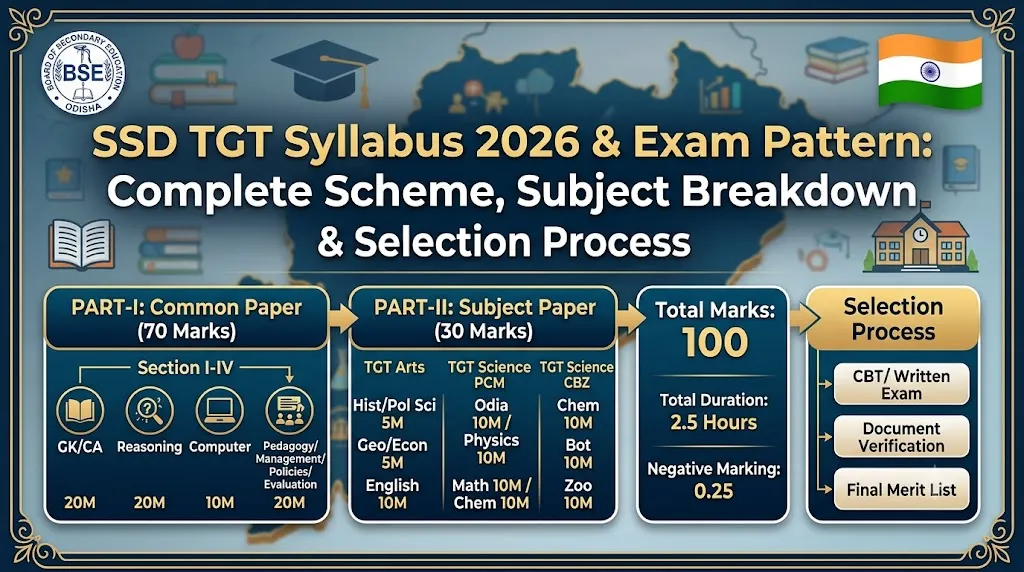
The SSD TGT recruitment test is a single-stage, objective written examination carrying 100 marks for a duration of 90 minutes. The question paper is divided into two parts: a 70-Mark Common Paper (Part-I) and a 30-Mark Stream-Specific Subject Paper (Part-II).
(Before diving into the detailed subject syllabus, explore our complete preparation guides for OSSTET 2026 Official Notification & Syllabus Guide and the Odisha Education Service (OES) Exam Complete Guide).
This ultimate master pillar guide provides an exhaustive breakdown of the official SSD TGT syllabus, exam scheme, negative marking rules, unit-wise topic lists for PCM, CBZ, and Arts streams, and proven preparation strategies.
SSD TGT Exam Pattern 2026: Key Highlights
The examination is conducted in an objective Multiple Choice Question (MCQ) format. Candidates must manage their speed and accuracy effectively due to the tight time constraint of 90 minutes for 100 questions.
| Exam Parameter | Official Details |
| Recruitment Body | ST & SC Development, M&BC Welfare Dept, Govt. of Odisha |
| Exam Name | Trained Graduate Teacher (SSD Schools) |
| Exam Mode | Offline (OMR-Based) / Computer Based Test (CBT) |
| Total Questions | 100 MCQs |
| Total Marks | 100 Marks (1 Mark per question) |
| Exam Duration | 90 Minutes (1 Hour 30 Minutes) |
| Negative Marking | 0.25 Marks deducted per wrong response |
| Structure | Part-I Common Paper (70 Marks) + Part-II Subject Paper (30 Marks) |
(Looking for other top graduate-level teaching and administrative careers in Odisha? Read our guide on the Top 10 High-Paying Government Jobs in Odisha After Graduation).
Part-I: Common Paper Syllabus Breakdown (70 Marks)
Part-I carries 70% of the total exam weightage and is mandatory for all teaching streams (TGT Science PCM, TGT Science CBZ, and TGT Arts). Questions in Sections I, II, and III are set in English, while Section-IV covers pedagogy and educational policies.
Section-I: General Knowledge & Current Affairs (20 Marks)
This section evaluates awareness of state, national, and global events:
- Current Events: Major developments of State (Odisha), National, and International importance.
- History: History of Odisha, History of India, and the Indian National Movement.
- Geography: Physical, social, and economic geography of India and the World.
- Polity & Governance: Indian Constitution, political system, and government initiatives.
- Economic & Social Development: Poverty alleviation, demographic trends, and social sector initiatives.
- Everyday Science: Scientific observations and everyday technological applications.
Section-II: Reasoning Ability (20 Marks)
Tests analytical thinking, problem-solving, and numerical aptitude:
- General Mental Ability & Logical Reasoning
- Analytical Ability & Spatial Reasoning
- Decision Making & Problem Solving
- Basic Numeracy & Data Interpretation (Tables, Graphs, Charts)
Section-III: Computer Literacy (10 Marks)
Focuses on practical Information and Communications Technology (ICT) usage in modern classrooms:
- Basic computer literacy skills for ICT integration in education.
- Hardware fundamentals, operating system terminology, and file management.
- Common applications (MS Word, MS Excel, MS PowerPoint).
- Networking, Internet, Emailing, Social Networking, and Digital Citizenship ethics.
Section-IV: Pedagogy, Educational Management, Policies & Evaluation (20 Marks)
A crucial pedagogy module designed to test teaching methodologies, psychological principles, and state policies:
- Child Development (Process of Growing Up): Concept & principles of growth and development, factors affecting development (nutrition, intelligence, psycho-social), adolescent counseling.
- Developmental Theories: Erikson’s Psycho-social Theory, Kohlberg’s Moral Development Theory, Piaget’s Cognitive Development, Vygotsky’s Social Constructivism, and Intelligence Theories (Thurstone, Guilford, Gardner, Sternberg).
- Learning Process & Pedagogy: Humanistic approach (Carl Rogers), Constructivist approach, conditions of learning (readiness, maturation, motivation), teacher-centric vs. learner-centric models, critical pedagogy, and classroom diversity/inclusive education.
- Educational Management: Management structures at National, State, District, and Sub-district levels (BRCs, CRCs, SMCs, SMDCs), School Development Plan (SDP) creation.
- Educational Policies & Frameworks: Kothari Commission (1968), NPE 1986, RTE Act 2009, NCF 2005, National Education Policy (NEP) 2020, SSA, RMSA, and Samagra Shiksha.
- Assessment & Evaluation: Formative, Summative, and Diagnostic Assessment; CCE implementation; Assessment of/for/as Learning; test construction principles and blueprint development.
(Enhance your pedagogy preparation by reviewing our complete OSSTET 2026 Exam Pattern & Section-Wise Marks Breakdown).
Part-II: Stream-Specific Subject Syllabus (30 Marks)
Part-II carries 30 Marks set at the Graduation Degree level. The subject distribution depends strictly on the candidate’s chosen stream.
- Physics 10M
- Chemistry 10M
- Mathematics 10M
- Chemistry 10M
- Botany 10M
- Zoology 10M
- History + Pol Sci 5M
- Geo + Economics 5M
- English Language 10M
- Odia Language 10M
1. TGT Science (PCM) Syllabus Breakdown (30 Marks)
The 30 marks are divided equally among Physics, Chemistry, and Mathematics (10 Marks / 10 MCQs each):
- Physics (10 Marks): Kinematics & Laws of Motion, Rotational Motion, Gravitation, Properties of Matter (Elasticity, Viscosity, Surface Tension, Bernoulli’s Equation), Sound & Wave Optics, Electrostatics & Gauss Law, Current Electricity & Magnetism, Electromagnetic Induction & AC Circuits.
- Chemistry (10 Marks): Atomic Structure (Bohr model, Quantum numbers), Periodic Trends, Chemical Bonding (VSEPR, Hybridization), States of Matter (Gas laws), Redox Reactions & Equilibrium (Le-Chatelier principle, pH), Extraction of Metals, Basic Organic Chemistry & Hydrocarbons.
- Mathematics (10 Marks): Set Theory, Relations & Functions, Quadratic & Linear Equations, Calculus of One Variable (Limits, Derivatives), Sequences & Series, Coordinate Geometry & Analytical Solid Geometry, Probability & Statistics, Trigonometry, Mensuration.
2. TGT Science (CBZ) Syllabus Breakdown (30 Marks)
Divided among Chemistry (10 Marks), Botany (10 Marks), and Zoology (10 Marks):
- Chemistry (10 Marks): Identical core syllabus as prescribed for the PCM stream.
- Botany (10 Marks): Plant Kingdom classification (Thallophyta to Angiosperms), Plant Tissue Systems & Secondary Growth, Photosynthesis (C3, C4, CAM plants), Plant Growth Regulators (Auxins, Gibberellins, Cytokinins), Plant Reproduction & Micropropagation, Mendelism & Genetics, Plant Diseases & Control Measures.
- Zoology (10 Marks): Taxonomy & Five Kingdom system, Cytology (Cell division, DNA/RNA), Genetics (Linkage, Mutation, Sex determination), Theories of Evolution (Darwinism, Modern Synthetic theory), Ecology & Biodiversity, Human Physiology (Nutrition, Respiration, Circulation, Excretion, Nervous & Endocrine systems), Human Reproduction & Development.
3. TGT Arts (Social Studies & Languages) Syllabus Breakdown (30 Marks)
Features a balanced mix of Humanities content and Language proficiency:
- History & Political Science (05 Marks): Great Ancient Rulers (Ashoka, Kharavela, Samudragupta, Harshavardhana), Maurya/Gupta/Kushana Art & Architecture, Delhi Sultanate & Mughal Era, Rise of British Power (1757-1856), Indian National Movement (1857-1947), World Wars & Russian Revolution, Indian Constitution, Preamble, Fundamental Rights/Duties, Union & State Executive, Local Governance, United Nations, Political Thinkers (Kautilya, Gandhi, Nehru, Ambedkar).
- Geography & Economics (05 Marks): Physical Geography of India (Physiography, Drainage, Climate), Natural & Energy Resources, Physical Geography (Landforms, Atmosphere, Ocean currents), Globe & Maps, Features of Indian Economy, Poverty, Unemployment, Inflation, and Economic Development.
- English Language (10 Marks): Comprehension, Functional Grammar, Vocabulary, Usage, and Writing skill concepts.
- Odia Language (10 Marks): Odia Grammar (Vyakarana: Samasa, Sandhi, Karaka, Vibhakti, Krudanta, Taddhita), Comprehension, and Literary usage.
(Preparing specifically for humanities teaching roles? Read our detailed guide on OSSTET TGT Arts & Odia Detailed Syllabus & 60-Day Study Plan).
Proven Preparation Strategy for SSD TGT 2026
To secure a rank in the SSD TGT merit list, candidates must manage both speed and subject accuracy:
- Prioritize the Common Paper (Part-I): Since Part-I carries 70% of the total marks, dedicate at least 60% of your daily study time to Reasoning, General Awareness, ICT, and Pedagogy.
- Master Educational Policies & Pedagogy: Thoroughly study NEP 2020, NCF 2005, RTE Act 2009, and constructivist learning theories to score full marks in Section-IV.
- Practice Time Management: You have only 54 seconds per question (90 minutes for 100 questions). Solve offline OMR mock tests regularly to build rapid decision-making skills.
- Avoid Blind Guessing: With a 0.25 negative marking penalty, leave questions unattempted if you cannot eliminate at least two incorrect options.
(Study environment matters during competitive preparation. Find dedicated study spaces using our guide to the Best Free Libraries and Reading Rooms in Bhubaneswar).
DOWNLOAD SSB TGT SYLLABUS PDF- CLICK HERE
Related Teacher Recruitment Resources on LearnOdisha
- OSSTET 2026 Master Notification, Eligibility & Online Form Guide
- OSSTET 2026 Eligibility Criteria, Age Limit & Final Year Rules
- How to Apply Online for OSSTET 2026: Step-by-Step Portal Guide
- SSB TGT Previous Year Question Papers & Answer Keys Download
- CT Entrance (D.El.Ed) Exam Preparation Tips & Syllabus
Frequently Asked Questions (FAQs)
What is the total mark and duration for the SSD TGT 2026 exam?
The examination consists of 100 Multiple Choice Questions (MCQs) carrying 100 marks to be completed in 90 minutes.
Is there negative marking in the SSD TGT recruitment exam?
Yes. There is a negative marking of 0.25 marks for every incorrect answer.
What is the mark distribution between Common Paper and Subject Paper?
Part-I (Common Paper) carries 70 Marks, while Part-II (Stream Subject Paper) carries 30 Marks.
Which department conducts the SSD TGT recruitment in Odisha?
The recruitment is conducted for residential schools under the ST & SC Development, M&BC Welfare Department, Government of Odisha.